Showing posts with label Holy places. Show all posts

Thursday, December 11, 2025

Chapter 6 — Guru Yoga in Action: The Outer, Inner & Secret Guru

Chapter 6 — Guru Yoga in Action: The Outer, Inner & Secret Guru

Introduction
Guru Yoga is often pictured as a formal practice performed in a shrine room. In Vajrayana it is that — and much more. When practised correctly, Guru Yoga trains our perception so that the teacher’s wisdom is recognized not only in the meditation cushion but in ordinary life. This chapter explains the three levels of the guru and shows why recognizing the guru is the heart of living Vajrayana practice.

What is Guru Yoga?

At its heart, Guru Yoga is a practice of connection — aligning our mind with awakened mind through devotion, visualization, and ethical conduct. The word “guru” here does not mean an infallible person; it points to a principle: a living transmission that awakens our basic goodness and wisdom. 


The Three Levels of the Guru

1. The Outer Guru

The outer guru is the teacher in human form — the one who gives instructions, corrects mistakes, and offers guidance. In traditional contexts this is a qualified teacher who embodies the lineage. Respect and appropriate devotion to the outer guru create conditions for realization.

2. The Inner Guru

The inner guru is our own Buddha-nature — the innate clarity and compassion present in every mind. Recognizing the inner guru means seeing our own wisdom-mind beneath habitual confusion. The outer guru points us to this inner source. 

3. The Secret Guru

The secret guru is the vital teaching that appears within phenomena — the events, people, and experiences that mirror our mind. When we learn to read life as a teacher, every moment becomes an opportunity for practice.

Why This Threefold Teaching Matters

  • Integration: The three levels prevent extremes — blind worship of the person or solitary arrogance. Together they create a balanced path.
  • Practicality: Seeing the outer, inner and secret guru helps turn doctrine into daily living practice.
  • Safety: Proper understanding protects students from devotion becoming dependency or superstition. 


Guru Yoga as a Practice of Perception

Guru Yoga trains perception: we learn to notice how mind colors experience. The practice is not about forcing miracles; it is a gradual retraining so that we respond to life with awareness rather than habit. This retraining begins with devotion and is sustained by disciplined reflection and ethical conduct.

Key Elements of the Practice (Foundation)

  • Devotion (Devotional wakefulness): A heartfelt openness that fuels practice — not sentimental attachment, but a motivated wakefulness.
  • Ethical conduct: Devotion without ethics is hollow. Ethical behavior protects the practice.
  • Study and instruction: Texts, lineage stories, and the teacher’s guidance anchor the practice.
  • Meditation & visualization: Daily formal practice stabilizes the experience of guru presence. 

Common Misunderstandings

Some common confusions to avoid:

  • Guru ≠ infallible celebrity: The teacher is human, and mistakes can occur. Respect does not mean blind submission.
  • Not magical thinking: Guru Yoga trains perception and attitude — it is not a charm to force events to obey you.
  • Devotion is not dependence: True devotion supports independence by revealing our inner wisdom.

Short Practice Guidance (A Simple Daily Template)

For those who wish to begin a daily habit oriented to the inner and secret guru, try this simple template:

  1. Dedicate a brief moment: Sit for 5–10 minutes in the morning or evening.
  2. Simple refuge & aspiration: Recall the teacher, the path, and the motivation for awakening (bodhicitta).
  3. Visualize the guru briefly: Even a simple light or presence suffices — the point is connection, not artistic detail.
  4. Rest in awareness: Let thoughts pass without clinging; rest in a soft wakefulness for a few minutes.
  5. Dedicate the practice: Offer the benefit of this moment to all beings. 

How the Outer Guru Points to the Inner Guru

The outer teacher functions like a mirror: by responding to the teacher’s instructions, we discover our reactive patterns. Over time, this mirror allows us to recognize the inner guru — the stable clarity that is always present. In Vajrayana, skillful devotion accelerates this recognition.

When Phenomena Become Teachers (The Secret Guru)

Once the mind is trained, everyday events — pleasant or painful — can be read as instructions. Anger becomes a lesson in non-clinging; praise becomes a test of humility; illness becomes a reminder of impermanence. This is not fatalism; it is a practical skill for transforming experience into insight. 

Conclusion

Guru Yoga is not merely a shrine-room ritual. It is a transformative discipline that reshapes how we perceive the world. By learning the three levels of the guru and practicing devotion wisely, students can open to the continuous presence of wisdom in daily life. The next chapter will move from these foundations into practical, everyday examples — how to recognize the guru in traffic jams, criticism, kindness, and hardship.

— End of Chapter 6 —

If my writings or reflections resonate with you, you may support this Dharma page here — subscription starts from MYR 2.49/month (≈ USD 0.60)

Footnote 

This article is intended solely for general illustration and educational reading. It does not disclose any secret tantric texts or teachings, and makes no attempt to transmit esoteric instructions that are restricted or require formal empowerment. 

All effort has been made to respect the sacred boundaries of Vajrayana practice and to uphold the integrity of samaya vows and Dharma protectors.  

Thank you for reading. May you find peace and great bliss. Your support helps spread the Buddha’s precious teachings and turn the Dharma wheel in the world.

Aspiration for Bodhichitta:

May the precious Bodhichitta, which has not yet arisen, arise and not diminish, but rather increase further and further.

Dedication of Merit:

By this merit, may we swiftly attain omniscience. Having overcome the enemies of wrongdoing, may we liberate all beings from the ocean of existence, with its stormy waves of birth, old age, sickness, and death.

Note
I do not own or infringe any copyright on
the picture(s).
Picture(s) courtesy and credit to the rightful
distributors and/or studios
The picture(s) are intended for editorial use only.

Monday, July 4, 2022

The Unsolved Mysteries in Tibet

In this post, we’ll introduce the top 9 Tibet’s unsolved mysteries for you, including Tibetan yeti stories, red snow in Himalaya, rainbow body phenomenon, Mount Everest flag cloud, Zhang Zhung culture, King Gesar storyteller, Guge Kingdom, gterma mystery, Shambhala and shaman of Tibet.
Tibetan Yeti or the abominable snowman of Tibet
As one of the world’s greatest unsolved mysteries, the abominable snowman of the Himalayas (Tibetan Yeti) has been always a hot topic among adventurers and explorers to tour Tibet. As early as 1784, the Tibetan abominable snowman has been mentioned in the written records for the first time. 
It’s reported that several people in the Himalayan region have witnessed Tibetan Yeti walking around and robbing local men for marriage. In recent years, some expedition groups have gone to eastern Tibet for further investigation, but whether the abominable snowman really exists is still a mystery.
Himalayas red snow
The surface of the Himalayas is often decorated with blood red spots. Seeing from a long distance, you would think it as red snow. Those red spots are made up of various algae, such as Chlamydomonas nivalis, Chlorococcum infusionum, Ankistrodesmus and so on. Widely distributed in the permanent ice and snow, the plateau algae have a strong cold resistance, making them alive even at -36℃. And due to red pigment in their bodies, they seem to be blood-like.
Mysteries of the Rainbow body
In Tibet and Central Asia, the Buddhist rainbow body tradition goes back to the 8th century, beginning with the great master Padmasambhava, but 20th and 21st-century documentation shows that this is no myth or legend — practitioners, from the highest lamas to the most humble lay people, have attained rainbow body.

Rainbow body is a mysterious phenomenon in Tibetan monasteries. It’s believed that only the senior Lamas who have made great achievements would pass away into a rainbow and enter the boundless palace at their parinirvana.
Mysterious Flag Cloud over Mount Everest
When it’s sunny, you can see a milky banner-shaped cloud floating on the top of mount Everest. That is called as mount Everest flag cloud, forming by convective clouds. Based on its location and height, we can deduce the wind force of Mt. Everest summit. If the flag cloud flutters upwards, the wind is much lighter, and vice versa. Thus, it gains the reputation as the world’s highest vane.
The Epic of King Gesar, a Legendary Tibetan Hero King Gesar is a heroic epic created by the Tibetans from a collection of ancient legends, myths, verses, proverbs and various other folk cultures of Tibet. Originating via folk oral traditions, history of King Gesar was passed down from generation to generation orally in a combination of song and narration for over 1,000 years. Meanwhile, kinds of legends about King Gesar storyteller also came out.

Among numerous narrators, the ones who are able to tell more than one version of King Gesar epic boast themselves as divine artists. That’s to say, the story of King Gesar they told is bestowed by the Gods. Some illiterate Tibetan teenagers, especially in Kham Area can unexpectedly narrate for King Gesar of ling with millions of words after illness or a dream. Till now, no one can explain this mystery.
Terma Tradition - This tradition of mystical discovery is known in Tibetan
Terma texts contain Buddhist teachings intended for troubled times as a source of renewed wisdom and blessings. Although there are antecedents in Indian Buddhism–most famously Nagarjuna’s discovery of the Prajnaparamita literature–terma is primarily a Tibetan phenomena.

The Tibetan word, terma, literally means “treasure” and refers to Buddhist (or Bon) scriptures and relics retrieved from the distant past through a process of revelation. There are two principal types of treasures: earth terma, discovered in the Tibetan and Himalayan landscape, and mind terma, discovered in the mind of the terton or “treasure revealer.” The latter should be distinguished with pure visions, or daknang, which appear in the mind of realized masters.
As Buddhist teachings, terma are most frequently traced to the eighth-century tantric master Padmasambhava, also known as Guru Rinpoche (literally “precious teacher”). According to treasure lore, during each of the tantric initiations he conducted, Padmasambhava appointed one of his disciples to reveal the associated set of teachings in a future lifetime. Afterwards, his principal disciple and consort, Yeshe Tsogyal, transcribed and hid these teachings throughout the Tibetan and Himalayan landscape.
Shambhala or Shangri-La is the mythological world
Shangri-La has become synonymous with any earthly paradise, particularly a mythical Himalayan utopia – an enduringly happy land, isolated from the world. In the novel, the people who live at Shangri-La are almost immortal, living hundreds of years beyond the normal lifespan and only very slowly aging.
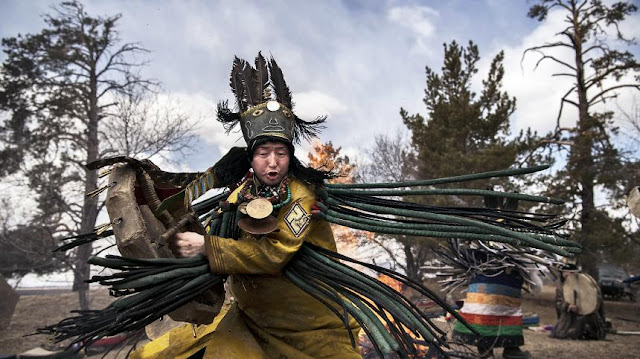
The mysteries of Tibetan Shamans
Tracing back to Tibetan primitive religion, Tibetan ancestors held that deities existed everywhere, like in the heaven, under the earth, in the waters, and all the living beings in the world are subject to those deities. With the development of human society, people had a fantasy of controlling the objective things and natural phenomena. 

The violent treatment of shamans by the Buddhist lama has a long history of Tibet and neighboring Mongolia. At one point, shamans were burned at the stake. However, in the mountainous Himalayan terrain, especially in the difficult to reach areas geographically distant from the Buddhist monastic urban centers, shamans were respected and their work revered.
Dana (Donations for our Buddhist research and development) 
Do you earnestly cherish our devoted work? Assuming this is the case, we are delighted that you are finding our blog useful and valuable. Would you consider making a donation for our Buddhist research and development?  

We need your help to secure the future of scholarly interaction with Buddhism. Since our very first publication of Dharma works and activities in the year 2008, we had been effortlessly providing free distribution of Dharma posts and articles throughout the previous 13 years.  We have exceptionally constrained supports and do not receive subsidized or funding from people in general. 

Please help us and to develop our Dharma activities that will not only benefit you, but to all Dharma readers on the planet. Please consider showing your support. Your generosity will certainly help us to enhance our work and to accomplish for a better and brighter prospect to come. 

Thank you for reading, may you find peace and great bliss. With your support it helps to spread the Buddha’s precious teachings and turning the Dharma wheels in the world.

*Note
I do not own or infringe any copyright of the picture(s).
Picture(s) courtesy and credit to the rightful distributors and or studios.
Picture(s) is/are intended for editorial use only.