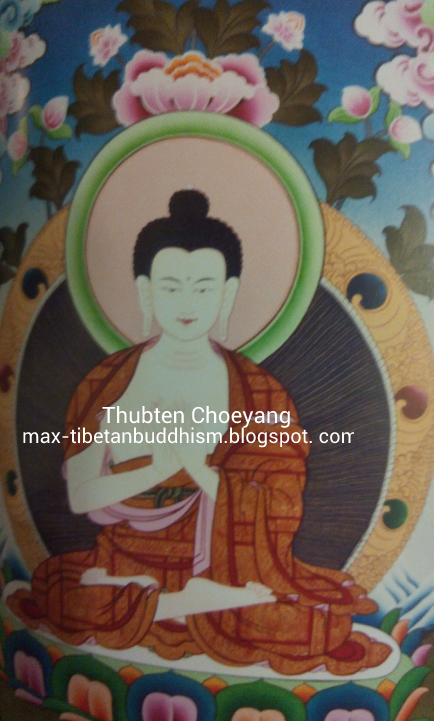
- Ratnasambhava Buddha. 寳生如來
- Akshobhya Buddha. 阿閦如來
- Vairocana Buddha. 毘盧遮那佛 / 大日如來
- Amithabha Buddha. 阿彌陀佛
- Amoghasiddhi Buddha. 成就如來
A journey to a mysterious Himalaya snow land and it's unique Vajrayana Buddhism and the threatening culture.
Wednesday, August 6, 2014
The Five Dhyani Buddhas 金刚界五智如来 - 寳生如來 Part 1
Saturday, October 25, 2014
The Five Dhyani Buddhas - Amoghasiddhi (成就如來) Part 5
The Five Dhyani Buddhas - Akshobhya (阿閦如來) Part 2
The Five Dhyani Buddhas -Vairocana (大日如來) Part 3
The Five Dhyani Buddhas - Amithabha (阿彌陀佛) Part 4
Thursday, November 17, 2016
The Sacred Universe of The Buddhas - Mandala
The Mandala is also a part of Hindu Tantrism and in other traditions like North American Indians, but this article will only focus on the Buddhist Mandala.
Mandala comes from Sanskrit meaning "circle." Even though it may be dominated by squares or triangles, a Mandala has a concentric structure. Mandalas are far more than geometrical figures, however. For Tantric Buddhists, they are rich with symbolism and sacred meaning. In fact, the etymology of the word "Mandala" suggests not just a circle, but a "container of essence."
Nyingma tradition and the teachings of Dzongchen or the Great perfection is the Highest Tantra. Nyingma lineage is the oldest of the four major schools of Tibetan Buddhism, and founded by the great Indian master of Guru Rinpoche, Padmasambhava who came to Tibet in the eighth century C.E.
For more teachings of the Tantra, please visit and click here
Construction of the sacred Mandala
The symbolizes of the sacred Mandala
Lines are then drawn through the center dot to the four corners, creating triangular geometric patterns. These lines are then used to construct a square "palace" with four gates. The monks usually keep to their own quadrant at this point.
- The four boundless thoughts: loving-kindness, compassion, sympathy and equanimity
Within the square palace or temple are images of deities, which are usually the * Five Dhyani Buddhas (the Great Buddhas of Wisdom). The iconography of these Buddhas are rich in symbolism in itself. Each of the Five Dyani Buddhas represents a direction (center, south, north, east and west), cosmic element (like form and consciousness), earthly element (ether, air, water, earth and fire), and a particular type of wisdom.
Each Buddha is empowered to overcome a particular evil, such as ignorance, envy or hatred. The Five Dyani Buddhas are generally identical in appearance, but are each represented iconography with a particular color, mudra (hand gesture), and animal. See the article on the Five Dyani Buddhas for more information.
In the center of the mandala is an image of the chief Buddha or Deity, who is placed over the center dot described above. Because it has no dimensions, the center dot represents the seed or the center of the universe.
*For more detailed of the Five Dhyani Buddhas, please visit our article as follows:-
http://max-tibetanbuddhism.blogspot.my/search?q=Dhyani+Buddhas+
The Destruction of The San Mandala
The sand is collected in a jar which is then wrapped in silk and transported to a river (or any place with moving water), where it is released back into nature. This symbolizes the ephemerality of life and the world.
Donation
Do you earnestly cherish our devoted work? Assuming this is the case, we are delighted that you are finding our blog useful and valuable. Would you consider making a donation for our Buddhist research and development?
We need your help to secure the future of scholarly interaction with Buddhism. Since our very first publication of Dharma works and activities in the year 2008, we had been effortlessly providing free distribution of Dharma posts and articles throughout the previous 10 years. We have exceptionally constrained supports and do not receive subsidized or funding from people in general.
Please help us and to develop our Dharma activities that will not only benefit you, but to all Dharma readers on the planet. Please consider showing your support. Your generosity will certainly help us to enhance our work and to accomplish for a better and brighter prospect to come.
Aspiration For Bodhichitta
For those in whom the precious Bodhichitta has not arisen
May it arise and not decrease
But increase further and further.
Dedication of Merit
By this merit may we obtain omniscience then.
Having defeated the enemies wrong-doings.
May we liberate migrators from the ocean of existence.
With its stormy waves of birth, old age, sickness and death.
*Note
I do not own or infringe any copyright of the picture(s).
Picture(s) courtesy and credit to the rightful distributors and or studios.
Picture(s) is/are intended for editorial use only.
Sunday, December 15, 2024
The Luminous One - Buddha Vairocana
Vairocana is often seen as the Dharmakaya, or supreme Buddha-body, of the historical Buddha, Gautama.
Vairocana is also the embodiment of wisdom and purity and the Buddhist concept of emptiness (sunyata).
Vairocana is often depicted in the Dharmachakra mudra, where the thumbs and index fingers of both hands touch to form a circle.Vairocana is a cosmic Buddha in Mahayana and Vajrayana Buddhism and an important figure in Buddhism in East Asia, Tibet, Nepal, and Java:
- MeaningVairocana is also known as the Luminous One, the Great Universal Light, and the Illuminator.
-
RoleVairocana is the original of the five Transcendent Buddhas of Vajrayana Buddhism. He is considered the primordial Buddha and is thought to reside at the center of Buddhist cosmology.
- Vairocana is often interpreted as the dharmakāya of the historical Gautama Buddha. In East Asian Buddhism, Vairocana is also seen as the embodiment of the Buddhist concept of śūnyatā.
-
SignificanceVairocana's portrayal inspires people to rise above the ordinary and connect with the cosmic forces that permeate the cosmos.
Buddha Vairocana is a radiant symbol of enlightenment, wisdom, and universal compassion. Vairocana Buddha is a well-known and iconic figure in the Mahayana school of Buddhism, particularly in the Vajrayana and kindred esoteric traditions.
Who is Virochana in Buddhism?In Tibetan Buddhism, Vairocana Buddha is known as Namnang or Nampar nangdze. He is a central figure in Buddhism, representing the essence of Dharma realm meditation mudra and the profound wisdom of Sunyata.
What is the symbol of the Vairocana Buddha?
What is the meaning of the Buddha Vairocana mantra?
The translation of this mantra is Praise be to the unfailing, all-pervasive illumination of the great mudra (or seal of the Buddha), the jewel, the lotus, and the radiant.
Do you earnestly cherish our devoted work?Assuming this is the case, we are delighted that you are finding our blog useful and valuable. Would you please consider making a donation for our Buddhist research and development?
Please support us via PayPal here:
Vajrayana features countless skillful and powerful methods that, if practised in the proper way, can make the process of accumulation and purification incredibly swift and direct.
It is absolutely necessary to have pure motivation and to know that Vajrayana practise is not carried out to increase one’s own ego, power, or self-interest.
Thank you for reading. May you find peace and great bliss. With your support, it helps to spread the Buddha’s precious teachings and turn the Dharma wheels in the world.
For those in whom the precious Bodhichitta has not arisen
May it arise and not decrease.
But increase further and further.
By this merit, may we then obtain omniscience then.
Having defeated the enemies wrongdoings
May we liberate migratory from the ocean of existence.
With its stormy waves of birth, old age, sickness, and death.
I do not own or infringe any copyright on the picture(s).
Picture(s) courtesy and credit to the rightful
distributors and/or studios
The picture(s) are intended for editorial use only.